Tell us about the job
Takes about a minute. No obligation.
A contractor quoting a mini-split repair in Mason County has to work out what actually wore the system down, and the weather record rarely points to the answer. 31 severe weather events were recorded in Mason County, Michigan between 2015 and 2024. At that rate, severe weather is an occasional event rather than a standing pressure on equipment. Compressors, fan motors, and refrigerant lines in this area are not accumulating damage from relentless seasonal stress. What a contractor finds instead when a system fails here is usually a component at the end of its service life, a refrigerant charge that was never right, or a mounting issue that has been vibrating a joint loose for years.
Mini-split systems installed in houses built for a different era of heating and cooling carry a particular repair profile. Half the homes in Mason County, Michigan were built in 1976 or earlier (2020-2024 ACS 5-year). A unit that has run through that many heating seasons in a house with variable insulation and air sealing tends to show wear in the refrigerant circuit and condensate handling before anything else. When a contractor opens the system, those are the components that tell the story: whether the charge is correct, whether the drain line has backed up and stressed the board, and whether the parts the unit takes are still in production.
The Parts of a Mini-split a Contractor Checks First
The indoor air handler mounts high on a wall inside the room and is the piece a homeowner notices most. It pulls room air across its coil and moves conditioned air back out. When it is the source of the problem, a contractor finds a frozen coil, a blocked drain line, or a fan that has stopped moving air.
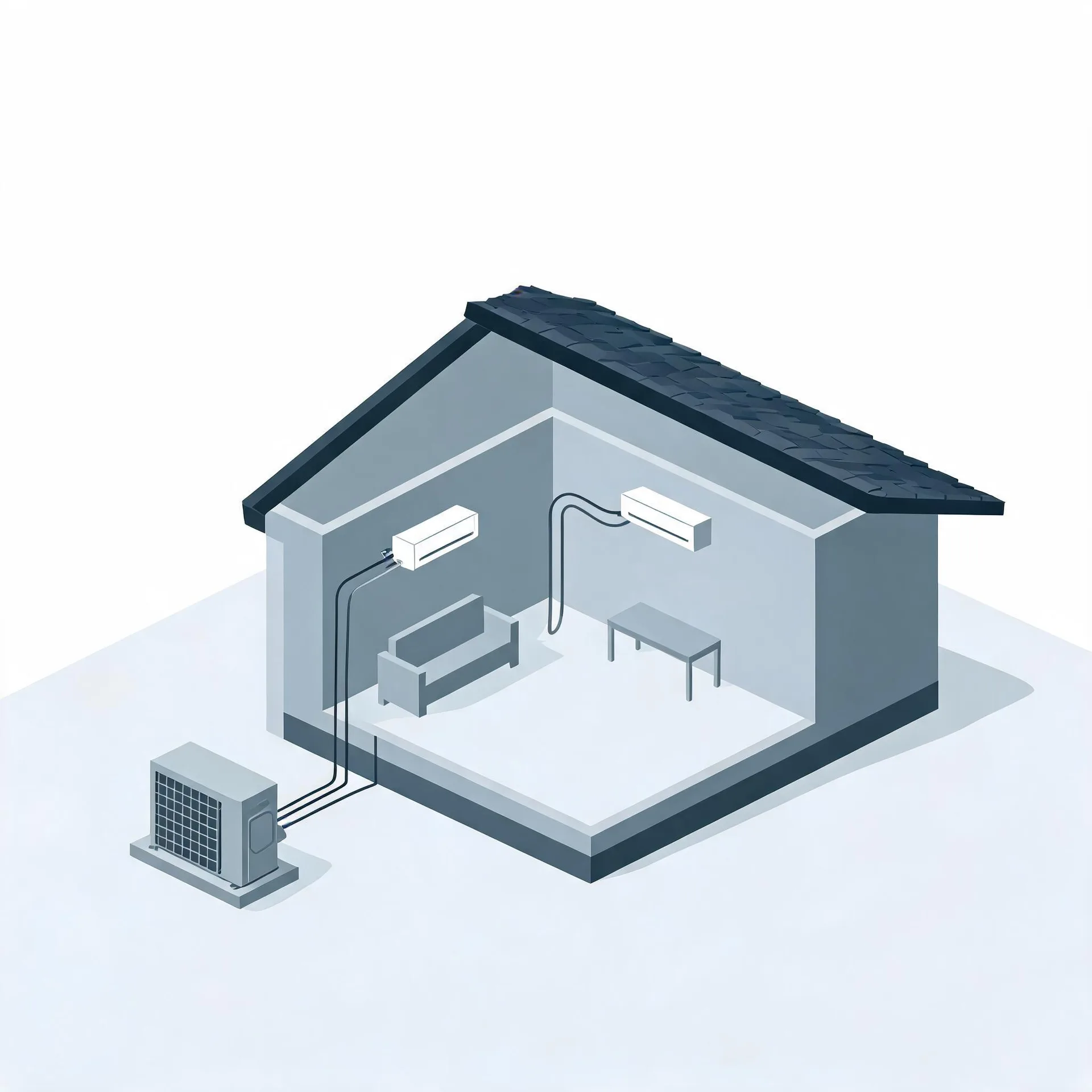
The outdoor condenser unit sits on a pad or bracket outside the house and holds the compressor and the coil that releases heat to the outside air. A refrigerant line set and a condensate drain line run through a small hole in the wall and connect the two units. The compressor and the refrigerant circuit are where a contractor looks when the indoor unit runs but the air temperature is off.
The drawing shows a typical mini-split layout, and a licensed contractor determines which components are relevant to your specific house and situation.
Get matched in Mason CountyMason County, Michigan, by the numbers
31 severe weather events were recorded in Mason County, Michigan between 2015 and 2024.
NOAA National Centers for Environmental Information, Storm Events Database, bulk CSV export, events 2015-01-01 through 2024-12-31.Half the homes in Mason County, Michigan were built in 1976 or earlier (2020-2024 ACS 5-year).
U.S. Census Bureau, 2020-2024 American Community Survey 5-Year EstimatesMason County, Michigan holds 17,596 housing units (2020-2024 ACS 5-year).
U.S. Census Bureau, 2020-2024 American Community Survey 5-Year EstimatesOwners occupy 78.3% of the occupied homes in Mason County, Michigan (2020-2024 ACS 5-year).
U.S. Census Bureau, 2020-2024 American Community Survey 5-Year EstimatesRepair Rules for Mini-Split Work in Mason County, Michigan2 codes, standards, and licensing rules
Licensing and Legal Requirements in Mason County, Michigan
Michigan issues the mechanical contractor’s licence by classification: HVAC equipment, ductwork, refrigeration, hydronic heating and cooling, and limited or unlimited heating and refrigeration service are each a separate classification a contractor has to hold.
Michigan requires a mechanical contractor’s licence: nobody may install, alter or service the regulated mechanical work unless they, or an employee, hold a licence from the department that has not been revoked or suspended.
Severe Weather Events in Mason County, Year by Year
Heating and cooling equipment in Mason County works against whatever the weather brings, and that workload shapes how hard components run and how often they fail. Repair needs here are tied to local conditions, which is why the weather record belongs alongside the equipment conversation.
31 severe weather events, 2015–2024. Source: NOAA National Centers for Environmental Information, Storm Events Database.